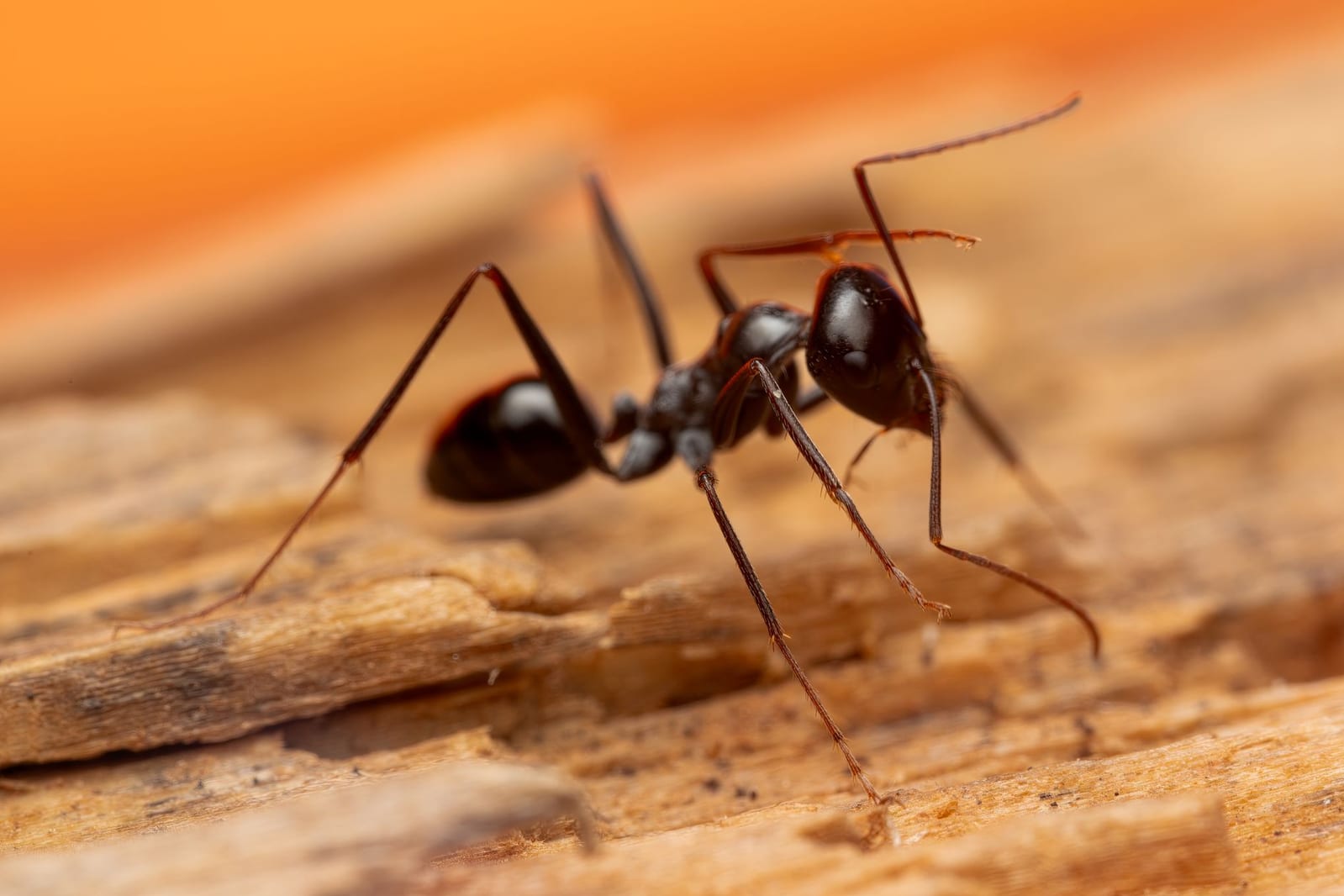
Carpenter ants (Camponotus pennsylvanicus, the large black species most NYC residents encounter) are the ant problem that actually warrants a licensed exterminator. Unlike pavement ants foraging for crumbs, carpenter ants are excavating galleries inside wood — the damp floor joists of a pre-war brownstone, the rotting window sill of a top-floor apartment, the water-damaged parapet wall of a flat-roofed building. The frass they push out — coarse, fibrous sawdust mixed with insect body parts, nothing like the powdery frass of termites — is often the first sign that structural wood is being hollowed.
The critical thing to understand about carpenter ants in a NYC building: the colony you're treating probably isn't where you think it is. Most active infestations involve a parent colony in a moisture-damaged void — often behind a wall, under a flat roof, or in a damaged lintel — and one or more satellite colonies closer to the food source (your kitchen). Treating the satellite alone is how most DIY attempts fail. A licensed exterminator finds and treats the parent nest; moisture remediation keeps it from coming back.
In NYC's building stock — pre-war walkups, brownstones with original wood framing, flat-roofed buildings with chronic leak histories — carpenter ants thrive wherever water damage has softened wood. Tree limbs touching brick facades, condensation around window air-conditioner units, and parapet wall cap failures are the access and attraction points a 20-year NYC exterminator looks for first.
Are those large black ants in my NYC apartment carpenter ants — and are they dangerous?
University of Minnesota Extension explains that carpenter ants do not eat wood — they remove it to create galleries and tunnels for nesting, pushing the chewed-out sawdust outside. Their parent nests are found in moist or decayed wood from water leaks, condensation or poor air circulation, so an indoor carpenter-ant problem usually signals a hidden moisture issue that needs fixing too. (University of Minnesota Extension — Carpenter Ants)
University of Minnesota Extension describes how carpenter ant colonies operate as a parent nest plus one or more satellite nests: the parent nest needs moist wood, while satellite nests can hold workers, older larvae and pupae in drier wood closer to a food source indoors. This is why treating only the visible indoor foragers fails — the parent colony survives and re-seeds the satellites unless it is located and treated. (University of Minnesota Extension — Carpenter Ants)
University of California IPM explains why baiting beats spraying for ants: foraging workers carry small portions of bait back to the nest, where it is passed mouth-to-mouth to other workers, larvae and queens, killing the whole colony. Spraying around the foundation only kills the foragers you see, leaving the colony and its queens intact — so it will not provide permanent control. (UC Statewide IPM Program — Ants)
Penn State Extension notes that the swarming winged reproductives of carpenter ants are commonly mistaken for termite swarmers, but the two are easy to separate: ants have a constricted, pinched waist, elbowed (bent) antennae and front wings longer than the hind wings, whereas termites have a broad waist, straight beaded antennae and four wings of roughly equal length. (Penn State Extension — Carpenter Ants)
Utah State University Extension notes that odorous house ants — a common NYC look-alike for budding indoor colonies — get their name from the rotten, coconut-like smell they give off when crushed, a quick field test that separates them from pavement ants. About 3 mm long and brown-to-black, they readily nest indoors and reproduce by budding. (Utah State University Extension — Odorous House Ant)
Carpenter ants vs. termites — the two-minute identification check
| Carpenter ant | Eastern subterranean termite | |
|---|---|---|
| Waist | Pinched (petiole between thorax and abdomen visible) | Broad and uniform — no pinch |
| Antennae | Elbowed (bent at a clear angle) | Straight, beaded |
| Swarmer wings | Forewings noticeably larger than hindwings | All four wings roughly equal length |
| Frass / debris | Coarse, fibrous — looks like shredded wood mixed with insect parts | Fine soil/mud packed into galleries and mud tubes |
| Wood damage | Smooth galleries along the grain; clean inside (does not eat wood) | Galleries packed with soil and mud; never clean (eats wood) |
| Moisture requirement | Parent nest in already-softened, moist or decayed wood | Needs soil contact and high moisture; builds mud tubes |
How much does carpenter ant & ant control cost in NYC?
$60–$500
National average: $150–$250 per visit (Angi). Typical single treatment: $80–$500 (small infestation). Bob Vila national range: $60–$215. Follow-up/retreatment visits: $40–$120.
US national figure — NYC typically runs higher.
Market range — not our quote
This is a market range synthesised from published cost guides — not a quote from this provider. The actual price depends on an in-person or photo-based inspection.
US national — NYC typically higher; no NYC-specific ant cost guide located, unlike bed bugs/rats/roaches.
What drives the price
- Infestation location (attic/basement/exterior walls cost more than kitchen/living space due to access difficulty)
- Severity
- Treatment method
- One-off vs follow-up retreatment
Signs you have a ant control problem
- Coarse, fibrous frass (not powder — more like shredded wood mixed with insect debris) near woodwork, windowsills, or along baseboards
- Large black ants (12–25mm) seen indoors, especially at night when foragers are active
- Rustling or crinkling sounds inside walls, particularly on quiet evenings — the sound of workers excavating galleries
- Winged swarmers (reproductive ants with wings) appearing indoors in late winter or spring — indicates an established colony nearby
- Soft or discoloured wood around windows, door frames, or where a roof or wall meets a parapet
Why Williamsburg sees this
Flat-roofed pre-war buildings are the highest-risk structure in NYC for carpenter ants — chronic parapet and roof drain failures soften the wood below the parapet cap, giving the colony a protected void that building staff rarely inspect.
Brownstone floor joists at or below grade level are a classic carpenter ant habitat — moisture wicks up from the basement, softening the sill plates and lower joists where the colony establishes.
NYC street trees with large canopies that touch building facades create a direct route from an outdoor colony into the building fabric — trimming limbs to maintain clearance breaks the access.
Carpenter ant swarms in late winter or early spring (February–April in NYC) are frequently mistaken for termites. The two-minute identification test: if the swarmer has a pinched waist and bent antennae, it is an ant; if the waist is uniform-width and the wings are equal length, call for a termite inspection.