Quick answer
Professional wasp nest removal typically costs $100–$1,300, with most jobs around $375. Paper wasp nests run $100–$400, bald-faced hornets $400–$800, and yellow jackets — often nesting underground or inside wall voids — $500–$1,300. Nests high on building facades or inside walls price at the upper end.
How much does wasp nest removal cost?
Professional wasp nest removal typically costs $100–$1,300, with most jobs landing around $375. The spread is wide because two factors stack: which species built the nest, and where they built it. A paper wasp nest under a porch eave is a quick, low-cost visit; a yellow jacket colony inside a wall void in September is a different job entirely.
| Species / situation | Typical range | Notes |
|---|---|---|
| Paper wasps | $100 – $400 | Exposed umbrella nests; eaves, railings, frames |
| Mud daubers | $300 – $600 | Solitary; mud tubes on walls; lowest risk |
| Bald-faced hornets | $400 – $800 | Large gray aerial nests; aggressive defense |
| Yellow jackets | $500 – $1,300 | Underground or wall/ceiling voids; most expensive |
| Height surcharge (above first story) | +$5 – $10 / foot | Ladder and access work |
| Follow-up visit (re-activity) | $150 – $350 | Concealed colonies sometimes need a second visit |
Ranges as of 2026, vary by provider, nest size, season, and access.
Why does the species matter so much?
Paper wasps ($100–$400) build the open, umbrella-shaped combs you see under eaves, window frames, railings, and grill covers. Colonies are small (dozens, not thousands), the nest is exposed, and treatment is straightforward — which is why they anchor the bottom of the price range.
Mud daubers ($300–$600) are the organ-pipe mud tubes on walls and in garages. They’re solitary and rarely sting; removal is more about cleanup and prevention than risk management.
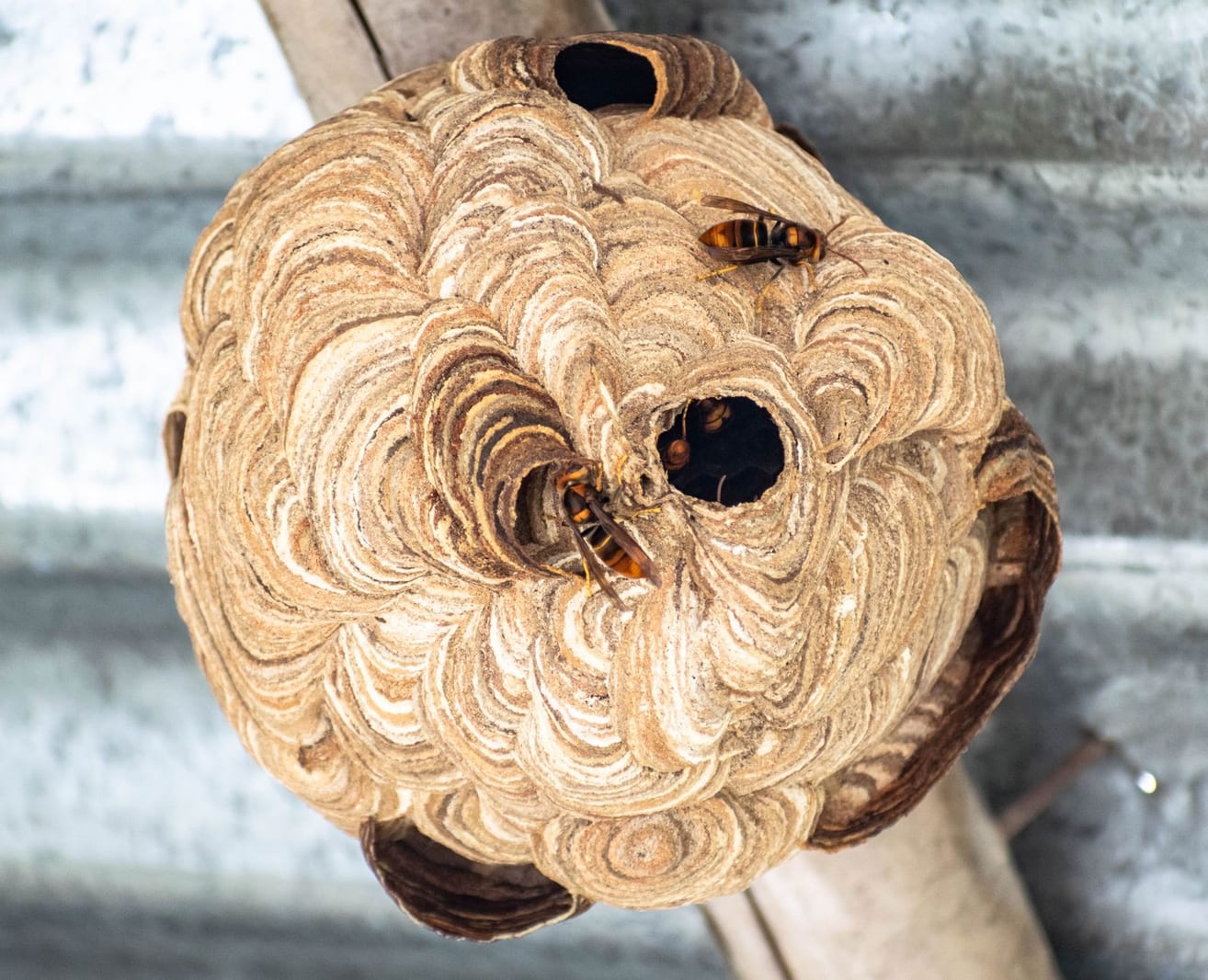
Bald-faced hornets ($400–$800) build the big gray football-shaped paper nests in trees and on building corners. Colonies are larger and defend the nest aggressively, so technicians treat in protective gear, often at dusk, before removing the nest.
Yellow jackets ($500–$1,300) top the range for three compounding reasons: colonies reach the thousands by late summer; they nest concealed — in the ground, in wall voids, behind siding, above ceilings; and they defend hard, with each insect able to sting repeatedly. A wall-void colony may require injecting treatment through the entry point and sometimes opening the void, because a killed colony left inside a wall can mean odor and secondary pest problems.
One more cost rule: size tracks the calendar. All these colonies start as a single queen in spring and peak in late summer. The same yellow jacket nest that’s a modest job in June is a maximum-difficulty job in September. If you spot early activity, act early — it’s genuinely cheaper.
What changes in NYC?
The species are the same; the buildings aren’t. NYC adds a few specific wrinkles:
- Height and access. Nests under cornices, atop window heads on upper floors, or on fire escapes trigger the above-first-story surcharge ($5–$10 per foot of height in published guidance) — and past a point, facade nests on larger buildings need building-managed access (roof rigging, scaffold) rather than a ladder.
- Wall and ceiling voids. Older masonry buildings are full of cavities behind cornices, in parapets, and around window frames. Yellow jackets exploit them, and void work is upper-range work. If wasps are entering a gap in the facade and appearing inside an apartment, treat it as urgent — never plug the hole yourself, which can drive the colony indoors.
- Fire escapes and balconies. Paper wasps love the undersides of fire-escape treads and balcony railings. These are cheap removals, but they’re also egress routes — a nest on a fire escape is a safety report to building management, not a someday job.
- Who pays. In rentals, exterior and common-area nests are the landlord’s to handle — NYC’s Housing Maintenance Code obliges landlords to keep dwellings free of pests. Report in writing. In co-ops and condos, facade and common elements are the building’s; private terraces are often the unit owner’s. Single-family homeowners: it’s you, and the species table above is your budget guide.
When is DIY reasonable — and when is it not?
A new paper wasp nest in April or May — golf-ball-sized, a dozen cells, a handful of wasps — can be handled with a labeled wasp spray applied after dark, when the colony is on the nest and sluggish. That’s the entire safe DIY envelope.
Outside it, the math flips fast. Established colonies attack in numbers when the nest is hit; yellow jackets and hornets will pursue; and the classic injury isn’t the sting, it’s the fall — off the ladder, on the fire escape, at the top of the stoop. Anyone with a known sting allergy nearby moves the answer to “professional” at any nest size. For step-by-step identification and the full DIY-vs-pro decision, see our guide to getting rid of wasps in NYC.
Getting an accurate wasp removal quote in NYC
Most providers can quote from a description and a photo taken from a safe distance. Have ready:
- A photo of the nest, or of the insects entering a gap if the nest is concealed
- Location and height: eave, fire escape, wall void, underground, tree
- How long it’s been active and roughly how busy the entrance is
- Whether anyone on site is allergic (changes urgency, not price)
- For buildings: whether management controls access to the area
Book through our stinging insect removal service page, or compare against other services in our full NYC exterminator cost guide.